OpenAI, Claude and Gemini API Prices and Korean Token Costs
Compare OpenAI, Claude and Gemini API prices per million tokens, plus our own count of 74 articles: Korean used 1.35 to 1.45 times the tokens of English.
 OpenAIC
- Category
- Comparison
- Official sources
- 3
- Read time
- 7 min
- Last checked
- 2026.09.24
All three providers price by million tokens
Each provider uses the same pricing structure: separate per-million-token rates for input and output tokens. The final charge is the sum of (input tokens × input rate) and (output tokens × output rate). Model names are secondary; focus on the two rate values.
Output tokens are consistently more expensive than input tokens across all providers. In most cases, output rates are approximately five times higher than input rates. Therefore, tasks that generate long responses—even with low input token counts—can incur high costs quickly.
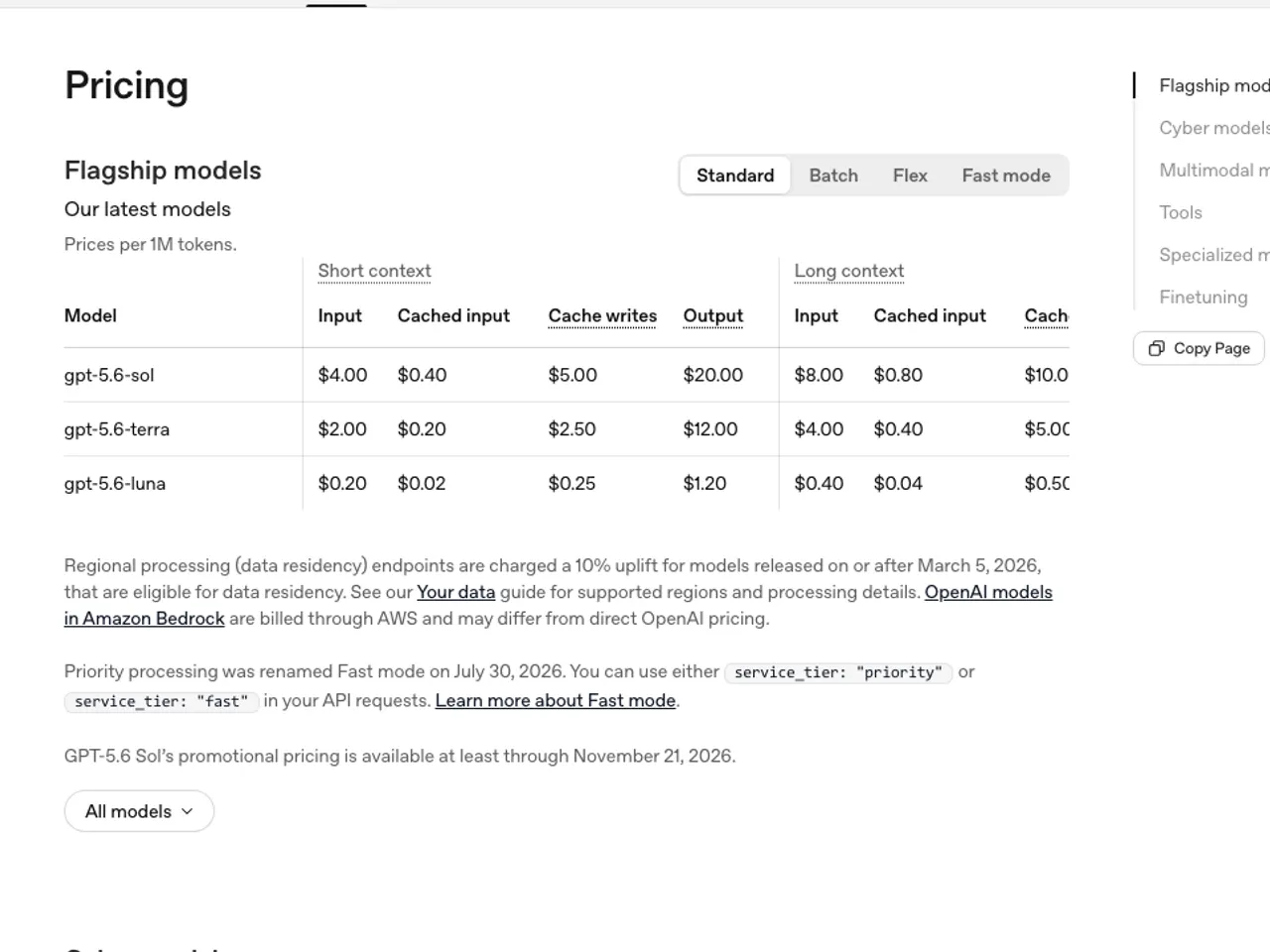
| Provider | Model | Input per 1M tokens | Output per 1M tokens |
|---|---|---|---|
| Gemini 2.5 Flash-Lite | $0.10 | $0.40 | |
| OpenAI | gpt-6-luna | $0.10 | $0.50 |
| OpenAI | gpt-4o-mini | $0.15 | $0.60 |
| Gemini 2.5 Flash | $0.30 | $2.50 | |
| Gemini 3.8 Flash | $0.75 | $3.75 | |
| OpenAI | gpt-5.4-mini | $0.75 | $4.50 |
| Anthropic | Claude Haiku 4.5 | $1.00 | $5.00 |
| Gemini 2.5 Pro | $1.25 | $10.00 | |
| Anthropic | Claude Sonnet 5 | $2.00 | $10.00 |
| OpenAI | gpt-6-sol | $2.00 | $10.00 |
| OpenAI | gpt-5.4 | $2.50 | $15.00 |
| Anthropic | Claude Opus 5.5 | $4.00 | $20.00 |
Cache input rates determine costs for repetitive tasks
For tasks that repeatedly prepend the same instructions, cache input rates must be considered. OpenAI applies significantly lower rates to cached inputs. For example, gpt-5.4 charges $2.50 for standard input but only $0.25 for cached input—one-tenth the cost.
This difference impacts total expenses in document summarization or rule-based batch processing where the prefix remains constant. If the prefix changes with each request, cache rates do not apply and should be disregarded.
| Model | Standard Input | Cached Input |
|---|---|---|
| gpt-5.4 | $2.50 | $0.25 |
| gpt-5.4-mini | $0.75 | $0.075 |
| gpt-4o | $2.50 | $1.25 |
| gpt-4o-mini | $0.15 | $0.075 |
Steps to calculate monthly costs
- Extract the number of requests and average input and output tokens per request from the past week’s logs, then scale to a monthly estimate.
- Divide the estimated input tokens by 1,000,000 and multiply by the input rate to calculate input costs.
- Repeat the same calculation for output tokens using the output rate and sum both values to estimate total monthly cost.
- If the same prefix is reused, count those tokens separately and recalculate using the cache input rate.
- Run the same input through both a high-end and low-end model to compare whether quality improvements justify the cost difference.
For example, a workload processing 20M input tokens and 2M output tokens per month would cost $22.50 with Gemini 3.8 Flash ($15 input + $7.50 output) but $60 with Claude Sonnet 5 ($40 input + $20 output), more than twice as much.
The Gemini 2.5 models are still on the official price list, but on 24 September 2026 calls from RS AI DESK's API key to Gemini 2.5 Flash, Flash-Lite and Pro all returned an error saying the model is no longer available to new users. If you are starting now, calculate with Gemini 3.8 Flash prices.
In 74 articles on this site, Korean used 35–45% more tokens than English
RS AI DESK measured how many more tokens the same content needs in Korean. On 24 September 2026 we counted the bodies of this site's 74 published articles and their English versions with OpenAI's public tokenizer (o200k_base) and with the Gemini API token counter (countTokens, Gemini 3.8 Flash).
| Tokenizer | Korean tokens | English tokens | Korean ÷ English | Characters per token (KO / EN) |
|---|---|---|---|---|
| OpenAI o200k_base | 119,080 | 82,115 | 1.45x | 2.01 / 5.07 |
| Gemini 3.8 Flash | 116,257 | 86,308 | 1.35x | 2.06 / 4.82 |
The Korean bodies had only 58% of the English character count yet more tokens. Per article, the Korean-to-English ratio ranged from 1.16x to 2.06x with OpenAI's tokenizer and 1.13x to 1.84x with Gemini's, with medians of 1.45x and 1.35x.
If you need a quick token estimate for a Korean document, count about 500 tokens per 1,000 characters including spaces. If you budgeted with English examples or calculators, check Korean workloads at 1.35 to 1.45 times the input and output cost.
The English versions are translations of the Korean articles, so sentence structure is not identical, and Markdown symbols such as headings and tables were counted too.
Claude's tokenizer was not measured this time; per-article figures are in the raw data file.
The ratio comes from one kind of text, explanatory articles about AI tools, so chat logs, code, table-heavy documents and other models' tokenizers can differ, and it should not be used as a cost factor for every Korean workload.
To reproduce it, take the per-article character and token counts from the raw data file and count the same bodies again with tiktoken's o200k_base encoding and the Gemini API countTokens call. Model selection is the primary cost driver in this scenario.
Selection depends on workload requirements
For classification or extraction tasks with short, straightforward answers, lower-tier models are cost-effective. These models keep expenses in single-digit dollar ranges but may produce lower-quality responses for complex reasoning tasks.
For code generation or multi-step reasoning, higher-tier models are preferable. Although their rates are higher, they reduce retry frequency, potentially lowering total costs when failure rates are considered.
If starting with a free tier is required, Google’s Gemini API free tier may be suitable. However, data processed under the free tier may be used for product improvement, whereas paid tiers prohibit such use. For internal documents or customer data, select a paid tier.
Verify calculations against actual billing
After the first billing cycle, compare the calculated estimate with the actual charge. If the bill exceeds the estimate significantly, check retry logs for repeated failed requests consuming duplicate tokens.
Under normal operation, token totals in the provider’s usage dashboard should align closely with internal logs. Large discrepancies indicate shared API keys across projects or tools. Store API keys as environment variables, exclude them from repositories, and reissue keys immediately if compromised.
Rates are subject to change per provider policy, and some models have limited-time pricing: the Gemini 3.8 Flash rates above apply through December 31, 2026, and rise to $1.50 input and $7.50 output from January 1, 2027. Confirm current rates on each provider’s pricing page before finalizing budgets.
If multi-provider usage is restricted, designate one provider as primary and route failed requests to a secondary provider as an alternative.
Revision history · 2026-09-24
This article was revised against the provider’s official documentation. Korean note
Sources
OpenAI — OpenAI API Pricing (2026-09-24)
Google AI for Developers — Gemini Developer API pricing (2026-09-24)
Anthropic — Claude API pricing (2026-09-24)
Open provider document